Sign up for our newsletter!
Your data will be handled in compliance with our privacy policy.
Smoltek is facing a crucial phase in the company's development. After several years of technology development and strategic partnerships, the company is now conducting a rights issue of approximately SEK 60 million to accelerate commercialization in two markets with strong structural growth: semiconductors and green hydrogen.
The company’s patented technology platform is based on controlled growth of carbon nanofibers (CNF), which enables advanced component solutions with high performance and low material consumption. The technology is being developed through the subsidiaries Smoltek Semi, which focuses on ultra-thin capacitors for the chip of the future, and Smoltek Hydrogen, which develops components for cost-effective production of green hydrogen.
Through collaborations with Taiwanese ITRI and Heraeus Precious Metals, Smoltek has taken important steps towards industrial validation and future commercial agreements.
- We have built a strong technological foundation and established partnerships with leading players in our focus areas. Now it is about translating the technology into business. The rights issue gives us the opportunity to intensify work on customer projects, industrialization and commercialization, says CEO Magnus Andersson.
The net proceeds from the rights issue will be used, among other things, for customer-driven development, product adaptations, industrialization, sales efforts and continued research and development.
The rights issue constitutes the final step in the financing plan that the board of directors presented in December 2024. The goal is to create the conditions for positive cash flow from 2027 and at the same time strengthen the company’s position in two markets where the need for new material and component solutions is expected to increase for many years to come.
Smoltek addresses two global macro trends – the ever-increasing computing power of next generation processors, and the enormous demand for more energy that follows in its wake.
We enable the next generation of power.:
Smoltek’s CNF-MIM technology is specifically developed for stable power management in AI chips and high-performance computing (HPC), data centers, as well as RF applications and optoelectronics.
The CNF-MIM capacitor combines high capacitance density with low electrical losses (ESL and ESR), packaged in an extremely thin form factor that enables advanced chip integration. Through cost-effective manufacturing, Smoltek Semi builds more energy-efficient capacitors, independent of substrate, for the next generation of advanced chips.
Smoltek’s porous transport electrode (PTE) contains only 0.1 mg iridium per cm², but can produce as much hydrogen as a conventional polymer electrode, which requires many times more iridium per cm².
Our PTE technology has demonstrated confirmed electrode stability during iridium reduction. The technology has also been shown to provide reduced contact resistance in electrochemical cells, which is an important feature that provides higher efficiency and increased performance in both fuel cells and electrolyzers.
Reduced contact resistance in a fuel cell (especially PEMFC – proton exchange membrane fuel cell) is critical for improving performance and life. Contact resistance occurs primarily at the interfaces between cell layers, for example between the gas diffusion layer (GDL) and the bipolar plate.
Our innovations are based on over 20 years of research and know-how in nanotechnology. We have a broad patent portfolio for extensive intellectual property protection that currently consists of 97 granted patents within 21 families.
In total we can count a total of more than 120 individual patent assets (patents applied for and granted) covering CNF synthesis (controlled growth of carbon nanofibers) as well as processes and production methods at the application level.
Smoltek’s products (capacitors and electrodes) are manufactured using additive manufacturing technology. It is an industrial technology in which three-dimensional objects are created by adding material layer by layer. Unlike traditional machining, which cuts away material,
this method reduces waste and enables extremely complex geometries, more material variations and faster prototype manufacturing.
In our case, this means that we grow carbon nanofibers on a surface that is compatible with industrial electrical and chemical processes, and which are then coated with different metals, atomic layer by atomic layer.
The result is that we significantly increase the available surface area for chemical and electrical processes, which enables the manufacture of more compact and powerful applications in several different industrial sectors – applications that are more energy and cost-efficient.
Read more about the rights issue (Swedish and English): Företrädesemission 2026
Your data will be handled in compliance with our privacy policy.
News

July 27, 2026
Smoltek joins MAXBATT – a national industry consortium led by Chalmers University of Technology, where leading players such as Scania, AB Volvo and Volvo Cars are collaborating to develop the battery production of the future. For Smoltek, the membership represents a strategically important validation of the company’s nanotechnology.
News

July 2, 2026
Summarizing the financial news at the break point between June and July shows strong interest in Smoltek and trading in Smoltek shares. Our rights issue was heavily oversubscribed and Smoltek shares are now available for trading on several international marketplaces in addition to the main listing on the Spotlight Stock Market in Sweden.
News
June 12, 2026
Smoltek is facing a crucial phase in the company's development. After several years of technology development and strategic partnerships, the company is now conducting a rights issue of approximately SEK 60 million to accelerate commercialization in two markets with strong structural growth: semiconductors and green hydrogen.
News
April 20, 2026
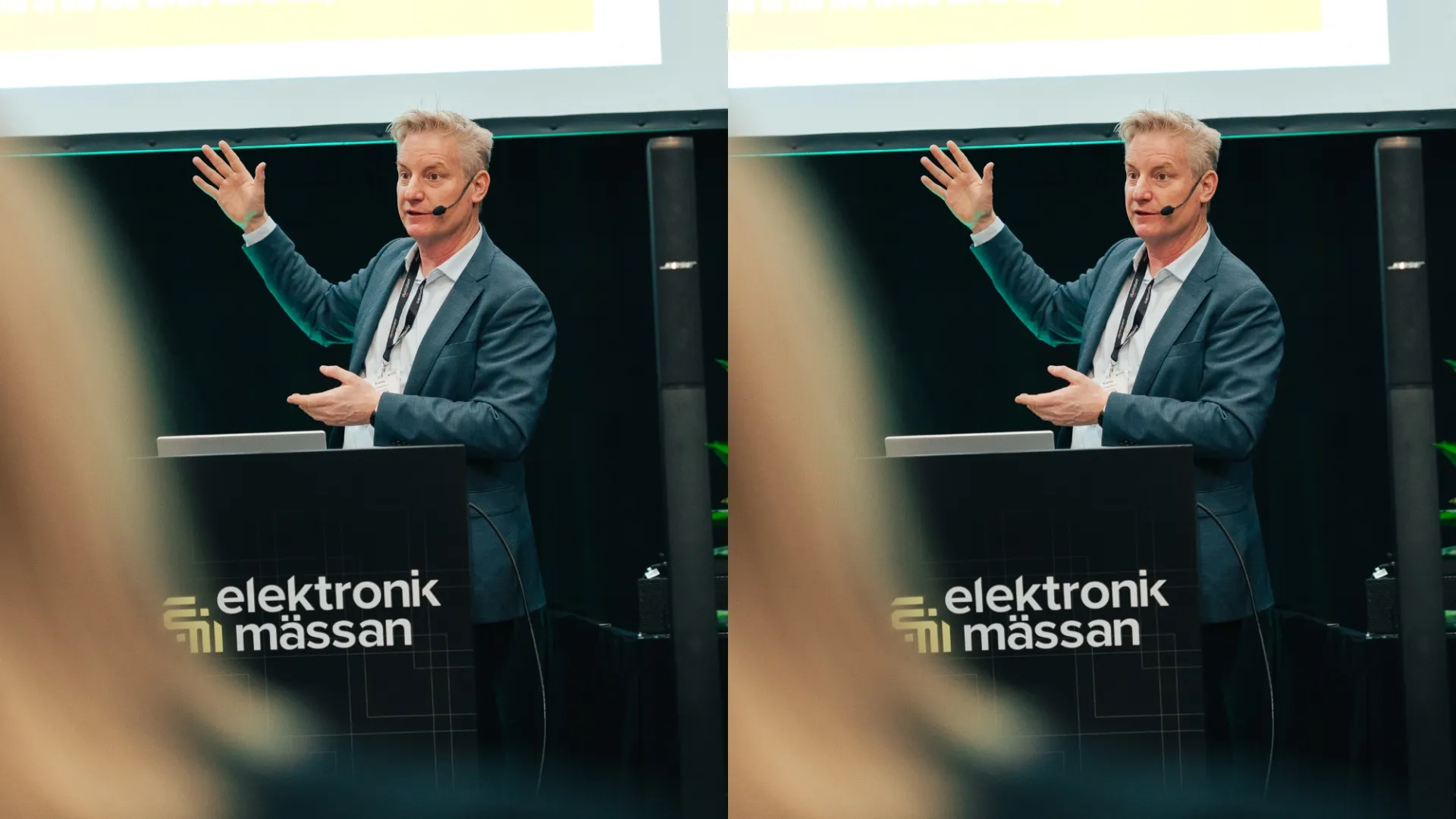
Nanoscale innovation becomes a strategic answer to a systemic challenge. Smoltek develops applications to future-proof both computing power and energy supply. This was the message at Elektronikmässsan 2026 from CEO Magnus Andersson.
News

April 9, 2026
Smoltek has appointed Gabriel Altby as Chief Financial Officer (CFO). He will assume the position on April 14, 2026, and will be part of the company’s management team with responsibility for financial governance, reporting and capital market-related matters.
News

November 20, 2025
We have launched a podcast about materials technology and investments in general and our disruptive carbon nanotechnology in particular.