Sign up for our newsletter!
Your data will be handled in compliance with our privacy policy.
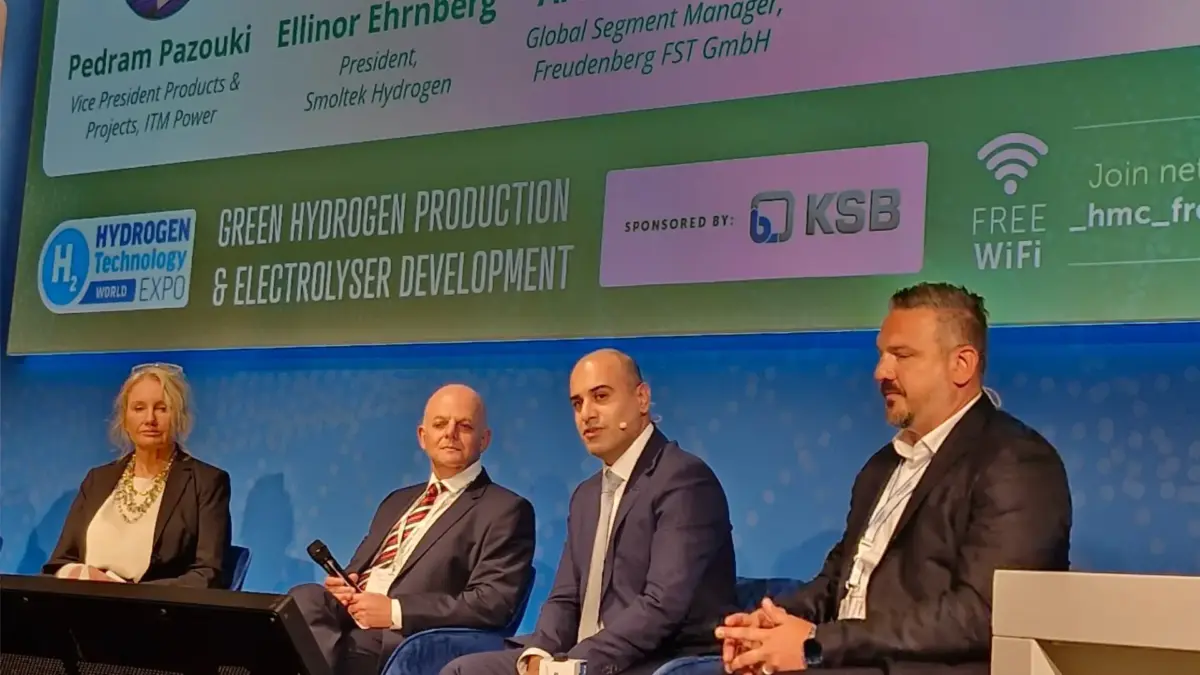
At the Hydrogen Technology World Expo 2025 in Hamburg, Ellinor Ehrnberg, President of Smoltek Hydrogen, joined a high-level panel to debate one of the industry’s most pressing challenges: How can green hydrogen be scaled fast enough—and affordably enough—to meet the world’s decarbonization goals?
Fredrik Liljeberg • October 29, 2025
On stage among major electrolyzer manufacturers and policy experts, Ellinor Ehrnberg, President of Smoltek Hydrogen, offered a refreshingly direct answer: “start with the atoms.”
“At the very heart of a PEM electrolyzer lies iridium. That’s where the magic happens. When a water molecule meets iridium, is splits into oxygen and hydrogen. This process can be made repeatedly at an affordable cost, as long as we just pour in more water. But iridium is different story; it is one of the rarest metals on Earth, more expensive than gold — and we can’t produce so much more of it,” Ellinor Ehrnberg explained.
Every proton exchange membrane (PEM) electrolyzer depends on iridium as its catalyst to split water into hydrogen and oxygen. The problem? Only 7–9 tons of iridium are mined globally per year, mostly in South Africa and Russia, and production cannot be scaled up. This makes the world’s green hydrogen ambitions severely constrained.
“At today’s small hydrogen volumes, using 2 milligrams per square centimeter is manageable. But if we want to scale to hundreds of gigawatts, it simply isn’t possible. The limited supply of iridium will stop the hydrogen economy before it even starts—unless we use it more efficiently,” Ellinor Ehrnberg continued.
Smoltek Hydrogen’s answer is a nanotechnology breakthrough that dramatically extends the life of this precious resource. Using a proprietary Porous Transport Electrode (PTE) built with corrosion protected carbon nanostructures the company has increased the active surface area of the catalyst layer by up to 30 times.
This allows iridium atoms to be applied precisely where they are needed—and nowhere else. The result is a 95% reduction in iridium use, down to just 0.1 milligram per square centimeter, while maintaining full performance and durability.
“We can make the electrolyzer up to three times more compact. Instead of three stacks, you only need one. That’s how we make green hydrogen truly scalable,” Ellinor Ehrnberg noted.
The cost savings are just as striking. “Using only five percent of the iridium saves several thousand euros per square meter of stack area. That’s real money—and real scalability”, she said.
In summary: Smoltek Hydrogen’s PTE technology enables smaller, more cost-efficient electrolyzers that require significantly less iridium. This innovation allows for a more compact stack design, reducing both system size and overall cost — saving thousands of euros per square meter of stack area.
But who will manufacture these PEM electrolyzers that will unlock the green hydrogen economy?
Ellinor Ehrnberg emphasized that no single company can solve the materials challenge alone “Collaboration is the only way to make such precision scalable. We are fortunate to work with partners who share our vision of building a sustainable hydrogen economy through smarter materials engineering.”
Today Smoltek Hydrogen has established industrial partnerships with Heraeus Precious Metals, AGC Plasma Technologies, Spark Nano, and Impact Coatings, alongside other undisclosed global technology leaders. These partners and customers are helping Smoltek move from prototype to production-scale systems.
“We build nanostructures atom by atom—from titanium, platinum, and iridium—and we must co-develop each layer with partners across the value chain,” she added.
Beyond technological efficiency, Ellinor Ehrnberg believes resource circularity will define the future of hydrogen. “We have to use much less iridium—and recycle it,” she said. “Efficiency and circularity are key if we want to future-proof the hydrogen economy.”
In other words, innovation cannot come at the expense of sustainability. Every improvement must serve both the economics and the ecology of green hydrogen production.
While the conversation around hydrogen often focuses on scale—more electrolyzers, larger plants, bigger numbers— Ellinor Ehrnberg cautioned against equating volume with progress.
“Scaling green hydrogen isn’t just about producing more—it’s about producing smarter.
We need to rethink the materials, the manufacturing, and even the mindsets that built yesterday’s industry. Every atom count,” she said.
That sentiment captured the spirit of this year’s Hydrogen Technology World Expo: that breakthroughs in materials science, not just policy or funding, will determine how fast the hydrogen transition can truly accelerate.
From its base in Gothenburg, Smoltek Hydrogen is demonstrating how deep materials expertise can unlock the next era of renewable energy. By combining nanostructured engineering with industrial partnerships, the company is helping make green hydrogen production both cost-effective and resource responsible.
Smoltek’s technology directly addresses one of the hydrogen industry’s most critical pain points—the iridium bottleneck—and in doing so, it opens the door to the mass deployment of fossil-free hydrogen needed to decarbonize heavy industry, transportation, and energy storage.
As the energy world pivots from promise to implementation, Smoltek’s message from Hamburg was clear: “We can’t create more iridium, but we can use what we have infinitely better. And that’s how we make the hydrogen economy truly sustainable,” Ellinor Ehrnberg concluded.
Before leaving the stage, she reminded the hydrogen community: “So, please — stop putting thick layers of iridium on membranes. Use thin, efficient layers on electrodes instead. Because every atom counts.”
And with these closing words we leave Hamburg, for this time.
Your data will be handled in compliance with our privacy policy.
News

November 11, 2024
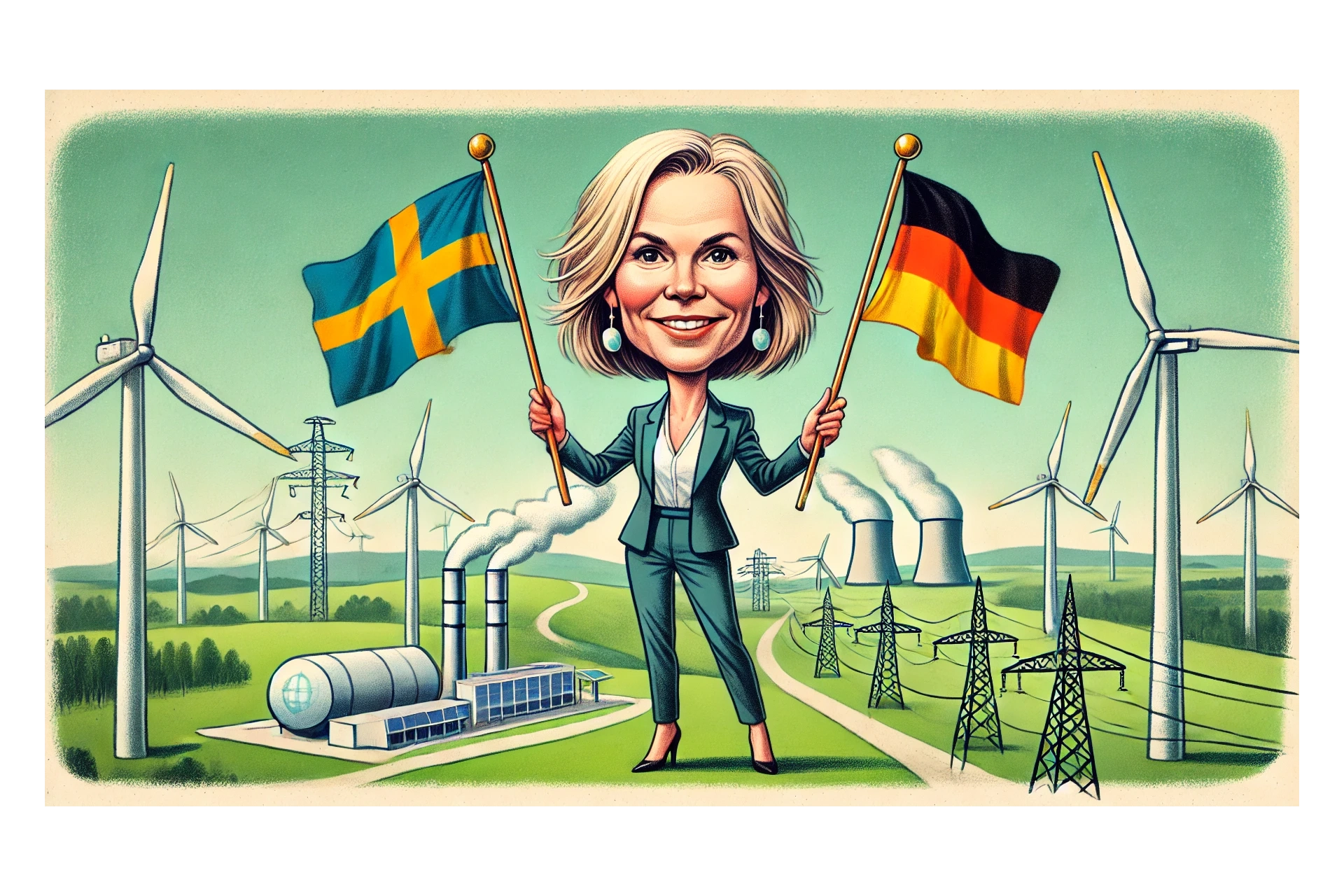
Smoltek Hydrogen has been invited to participate in a Scandinavian delegation of technology leading hydrogen companies for a round-trip to Germany’s energy-producing regions in Rhur and central Germany.
IR Blog Posts

January 15, 2025
When experts talk about the energy systems of the future, they often come back to one specific number: 0.1 milligrams per square centimeter (0.1 mg/cm²). This seemingly insignificant number could be critical to moving green hydrogen from a promising concept to an economic reality.
IR Blog Posts

April 14, 2025
Taking a breakthrough technology from the lab bench to the world market often requires collaboration with large industrial enterprises. In this interview, Ellinor Ehrnberg, president of Smoltek Hydrogen, explains how the company aligns its own development with that of potential buyers while navigating the complex journey from initial interest to strategic partnership.
IR Blog Posts

April 22, 2025
While traditional development processes often progress at a measured pace, truly disruptive technologies, such as Smoltek’s Porous Transport Electrode (PTE), can dramatically compress timelines. When faced with potentially market-changing innovations, industrial enterprises must choose between maintaining the status quo, slow internal development, or embracing partnership with innovative companies like Smoltek Hydrogen.
IR Blog Posts

January 16, 2025
In the race to make green hydrogen economically viable, researchers worldwide are pursuing the seemingly impossible: reducing iridium use in PEM electrolyzers by 95%. As Smoltek gets closer to this holy grail of 0.1 mg/cm², we examine how other technologies measure up.
IR Blog Posts
November 4, 2024
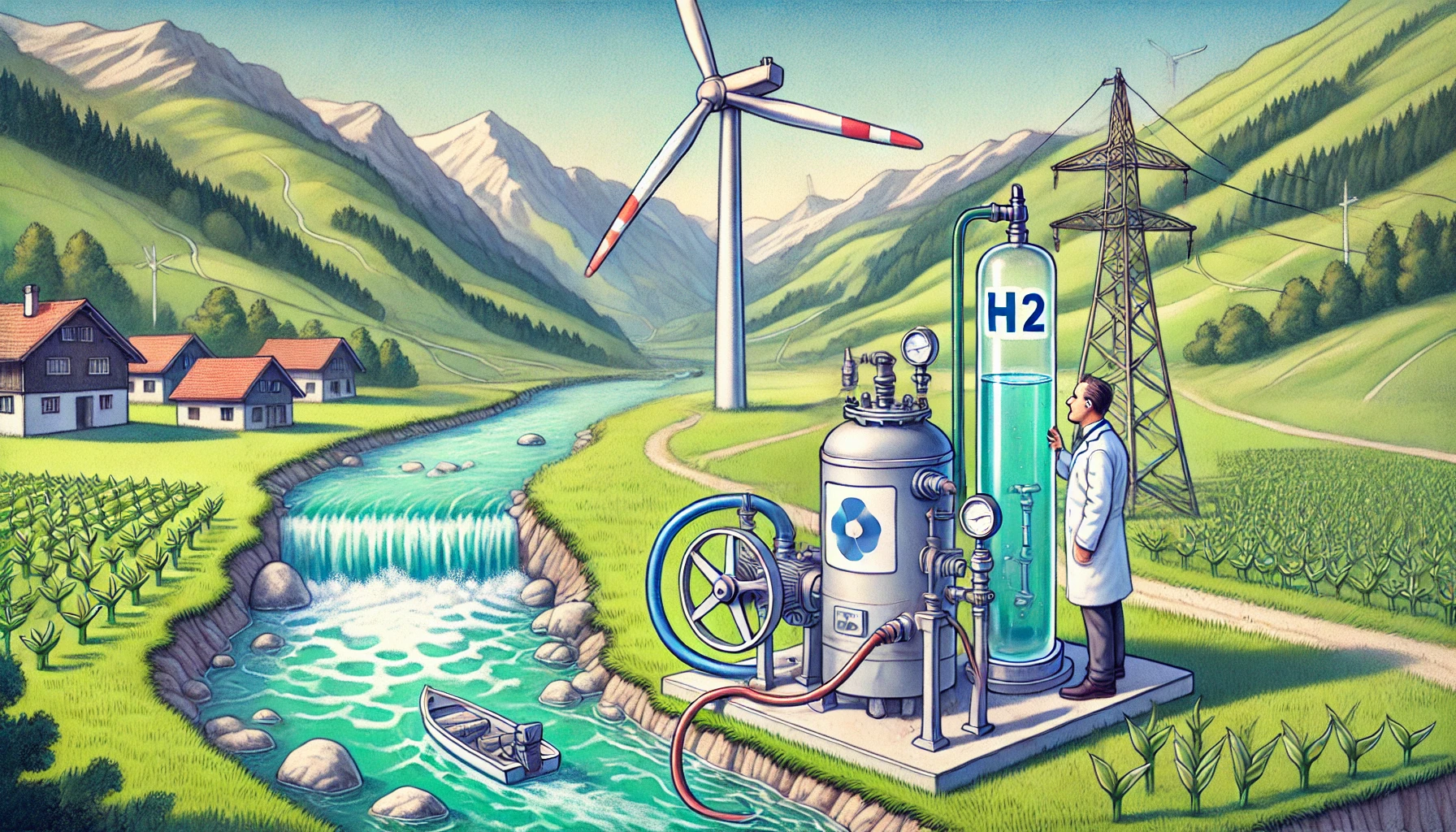
Discover how Smoltek’s innovative Porous Transport Electrode (PTE) technology stands up to expert scrutiny. Learn about its impressive performance, and why it’s poised to transform PEM electrolyzers. Get the inside scoop on what this means for Smoltek’s future in the green hydrogen market.