Sign up for our newsletter!
Your data will be handled in compliance with our privacy policy.

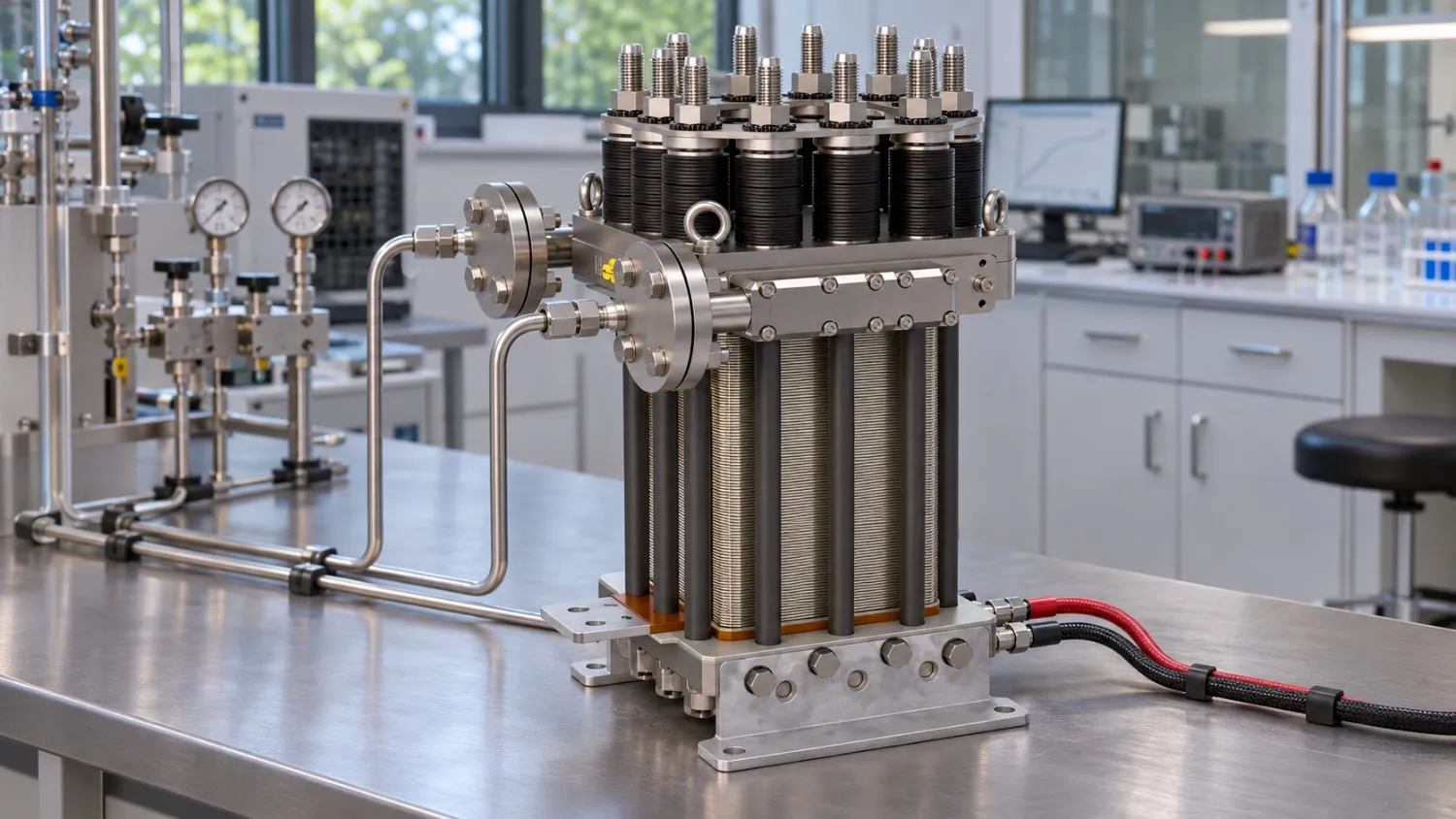
Green hydrogen needs to become cheaper, more efficient and easier to deploy. A new Letter of Intent between Smoltek Hydrogen AB and hyworx GmbH takes a concrete step in that direction: jointly integrate Smoltek’s porous transport electrode (PTE) into Hyworx's next-generation PEM electrolyzer stacks.
The collaboration begins with testing in a 4 kW Hyworx electrolyzer stack. The partners will further optimize iridium loading and develop current density, with joint stack testing planned from the second half of 2027. From there, the electrode technology is intended to follow Hyworx’s roadmap into its larger L- and XL-Series stacks, aimed at multi-megawatt deployments.
Iridium is one of the major cost drivers in PEM electrolysis. Smoltek’s nanostructured PTE is designed to make better use of the available iridium oxide catalyst, without ionomer or binder, so nearly all of the high-surface iridium can be active.
Smoltek’s anode PTE is targeting 0.1 mg iridium/cm², while remaining compatible with existing stack designs. The goal: reduce precious-metal content, increase power density, and help bring down the cost of green hydrogen.
Under the LOI, Smoltek and Hyworx will:
Less precious metal in every cell and more power from the same stack hardware is a direct lever on stack cost; and those savings can carry across Hyworx’s entire product family.
Fabian Wenger, Head of R&D at Smoltek Hydrogen highlights the operational upside: “Higher current density with only a fraction of the usual iridium can boost the rated power of each stack, enabling more hydrogen production when renewable electricity is abundant and inexpensive.”
This is a practical example of how advanced materials and stack design can work together: not just improving one component but building a scalable pathway from decentralized hydrogen production to megawatt-class plants.
The LOI is non-binding, and the stated timelines and performance figures reflect development goals and lab-cell testing rather than final commercial commitments.
Your data will be handled in compliance with our privacy policy.
News

October 12, 2026
Smoltek has engaged Maria Persson Gulda as a senior advisor to strengthen the commercialization of Smoltek Hydrogen’s electrode technology for PEM electrolyzers. Her assignment will focus on industrial customer requirements, product competitiveness and partnerships that can accelerate the path to market.
News

September 29, 2026
Smoltek’s technology for porous transport electrodes (PTE), developed in collaboration with Heraeus Precious Metals, has the potential to make green hydrogen economically viable. This is the conclusion drawn by the German tech channel Breaking Lab.
News
August 10, 2026
Together with Heraeus Precious Metals Smoltek Hydrogen develops next-generation, ultra-low iridium Porous Transport Electrodes (PTEs) for Proton Exchange Membrane (PEM) water electrolysis. As a major milestone in this partnership, the companies will initiate a rigorous 3,000-hour long-term durability test this autumn.
News

January 28, 2026
Smoltek Hydrogen, has been selected as one of nine Swedish cleantech companies to join the Swedish-German Cleantech Platform 2026. This strategic program, managed by the Swedish Energy Agency and the German-Swedish Chamber of Commerce, gives the opportunity to accelerate the company’s commercial expansion into Germany — Europe's leading and most dynamic market for green hydrogen and fuel cell technology.
News

November 20, 2025
We have launched a podcast about materials technology and investments in general and our disruptive carbon nanotechnology in particular.
News

November 4, 2025
Smoltek Hydrogen has received an order for samples of low iridium-load Porous Transport Electrodes (PTE) for PEM electrolyzers. The electrodes will be used in a joint development project with Heraeus Precious Metals, a global leader in precious metals.